ABSOLUTE ASCENDANCY
BUILD STRENGTH - ELIMINATE WEAKNESS - UNLEASH POTENTIAL
Gaming Zone – Project RAID

Commencing operation . . .
Overview
To most citizens of Black Metro, Overlord Drakow ‘Counter King’ is a mighty and enigmatic individual. Those who are more closely acquainted are familiar with the dry, witty, sarcastic sense of humour that Drakow often deals out. Fewer still are aware that Drakow is an experimentalist by design.
Intrigued to implement an AI version of himself, Drakow spearheads Project RAID (Research Artificial Intelligence Development).
And now, Drakow has engineered the perfect opportunity to test his new AI design. With advanced technology, political control, and a new super powered upgrade, can any of the candidates truly stand up to the might of Overlord Drakow and Project RAID?
Absolute Ascendancy is proud to announce Project RAID, the first expansion for Black Metro: The Board Game!
Black Metro Project RAID for Black Metro: The Board Game, available now.
This expansion features two advanced game modes – AI and RAID – both of which allow players to challenge the overlord of Black Metro!
AI Mode
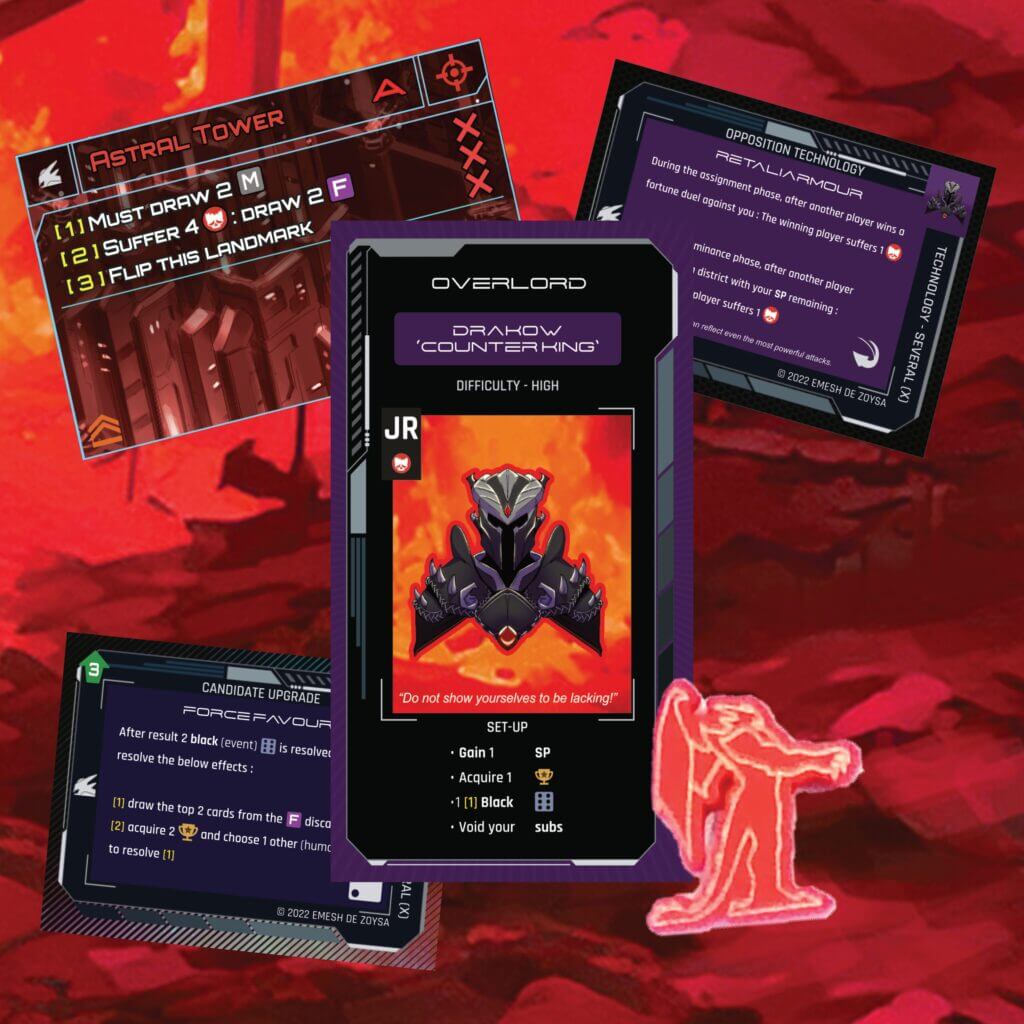
The overlord has many tricks to keep the pressure on. He always retains possession of the relic, so each round the players must be careful not to lean too heavily into any particular strategy, lest they risk detrimental impact from an event!
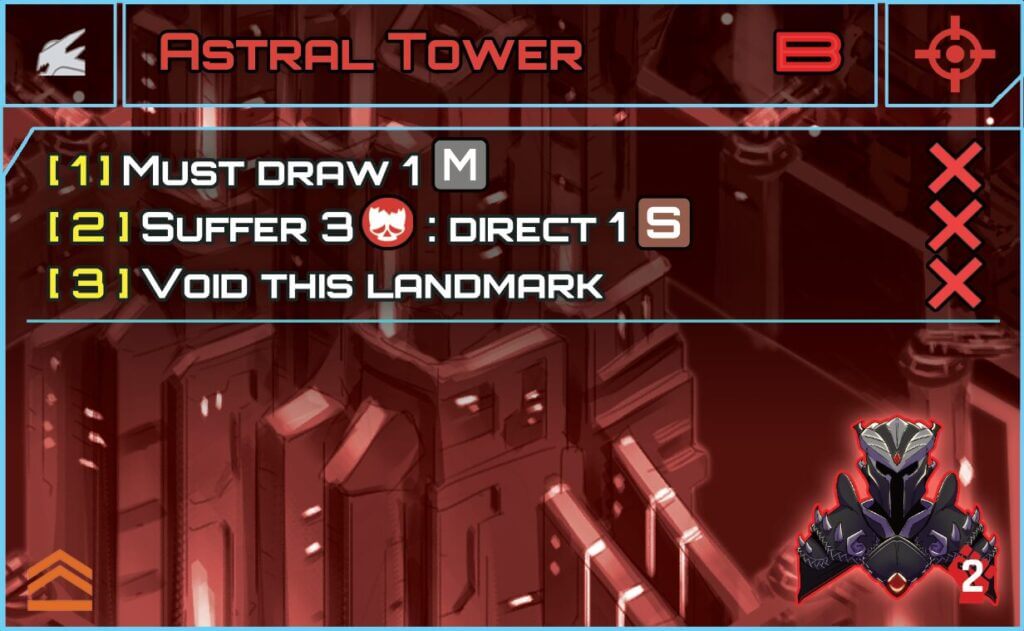
The Astral Tower’s defence systems have been primed, turning the district into a battlefield where the overlord has stationed his forces.
A new, secret upgrade has been developed, bringing forth a devastatingly powerful unit, the likes of which have never been seen before.
That is but a few things to anticipate when taking on the overlord!
This mode includes the overlord as an AI opposition (including solo mode). The overlord steadily builds up an army of special personnel throughout the game. These special personnel are assigned randomly to districts each game round, following the same principle as district explosion landmark placements.
Unlike candidates however, the opposition is allowed to reassign personnel to the same district, if the fortunes dictate so. This means that in later rounds, candidates should not necessarily attack the opposition’s early assignments, as there is a risk of enemy reinforcements dropping in unexpectedly!
Each round, the opposition’s final assignment is also reinforced with a fortification, making it more likely to overwhelm personnel already on the game board, while also giving candidates more to deal with on the board in future rounds!
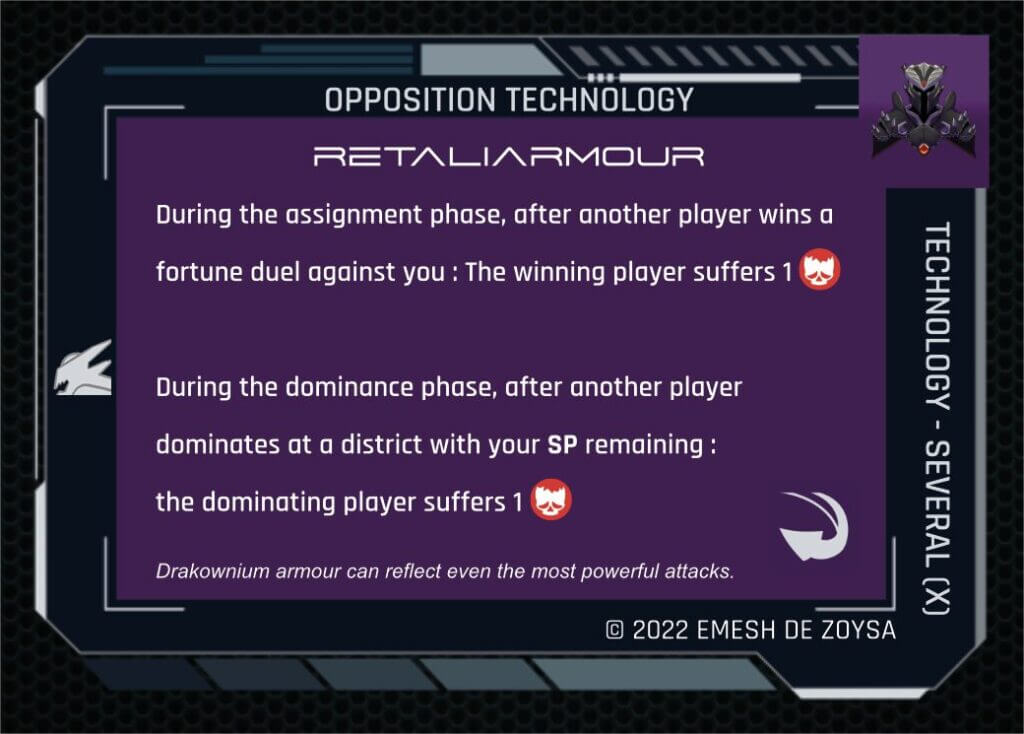
But even if candidates fight back against the overlord, such efforts will not go unpunished! The overlord has his unique, signature technology, Retaliarmour which will inflict strain upon candidates when they attack his forces. The opposition researches this technology first and then on following rounds, battle technologies are researched in ascending order of upgrade level. The last couple of rounds are particularly brutal, when candidates battle against an army of paragons, all equipped with death railguns.
But that’s enough talk about the opposition’s military might. Let’s take a step back and survey the political climate. Right from the get go, candidates are under pressure, as the overlord has placed the Astral Tower under lockdown; manipulated the syndicates to his benefit, and imprisoned the rest!
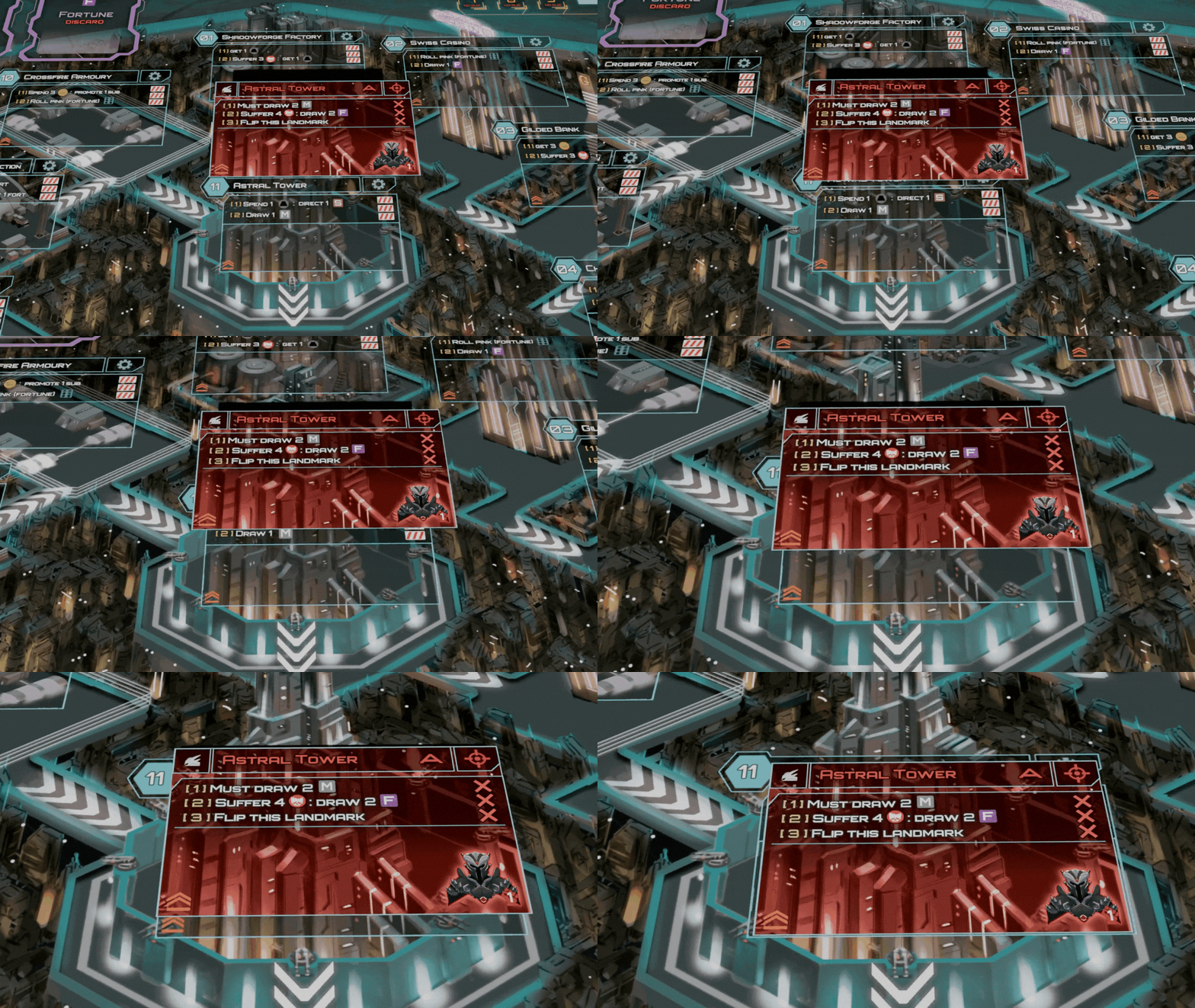
Candidates will need to assault the Astral Tower over the course of multiple game rounds, in order to normalise the district.
However, it will not be an easy task.
The opposition has readied the Astral Tower’s defence systems, so candidates will need to dominate the district, in order to break in. A single subordinate will not get the job done either, as the overlord always has strength at the district, which will need to be overcome, to force entry.
Upon successful infiltration, a candidate will be forced to take on extra missions. With the administrative district in disorder, it is up to the candidates to take on the extra workload and clean up the chaos! It may well be worthwhile for a candidate to further exert their personnel and rescue prisoners, who will all but gladly lend you their aid.
Flipping the landmark over to side B secures a route to the imprisoned syndicates. In response however, the Overlord tightens security, which will therefore require extra muscle power for a candidate to break in a second time. However, once a candidate manages to do so, they will have the opportunity to rescue the syndicates and restore order to the Astral Tower.
Next, let us discuss the relic. The opposition retains it for the entire game. Although this comes with the advantage of the opposition always assigning their personnel first, that is where the good news ends.
Because the opposition is most likely to assign personnel to district 12 Combat Zone (in comparison to any other individual district), there is a good chance that the opposition will score the full extra power each round, through dominance there.
The Wild Cards syndicate always starts in play – no matter the player count – and this is a syndicate that the opposition therefore is guaranteed to always receive backing from, while it is in play.
Whenever the event dice is rolled, effect [1] – the detrimental effect – is always triggered, and the overlord is immune to any drawbacks. Candidates who focus heavily on a particular strategy put themselves at great risk of getting severely punished should the relating event trigger.
Thinking of building fortifications across the city? Might want to reconsider. The overlord starts with 2 opposition missions, Overpower and Demolish.
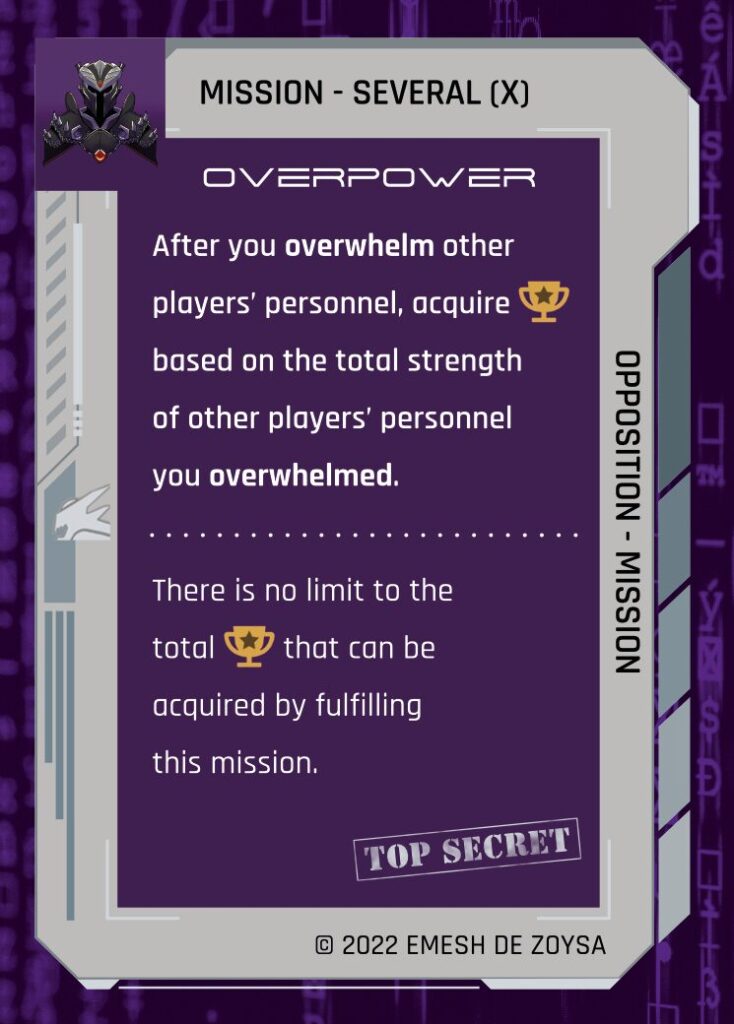
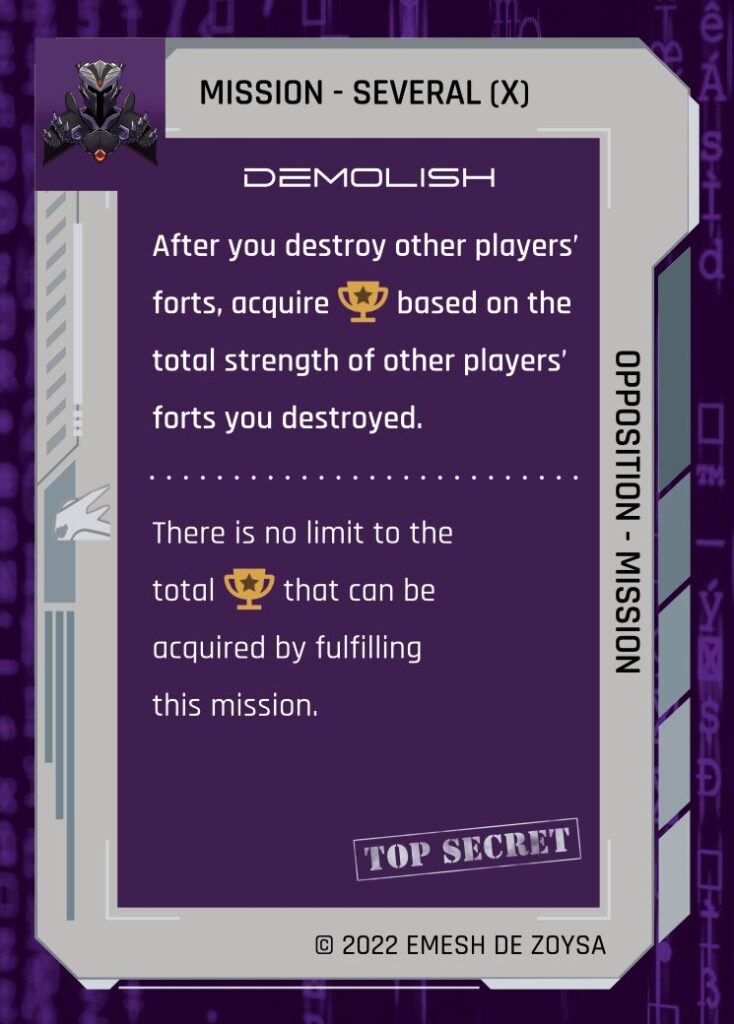
Each of these will reward the opposition for breaking candidates’ forces, whether it’s personnel or fortifications. Note that these missions are untapped in scoring potential. Another point is that these missions can be fulfilled at any time.
But how does one fulfil such missions outside of the dominance phase?
District explosions are treated as effects caused by the opposition, which means if a district explosion would destroy a candidate’s fortifications or overwhelm their personnel, this would satisfy the criteria for fulfilling the opposition missions, and yes, it is possible to fulfil both of them simultaneously!
Which leads nicely to the opposition district explosion landmark – the Searing Domain.
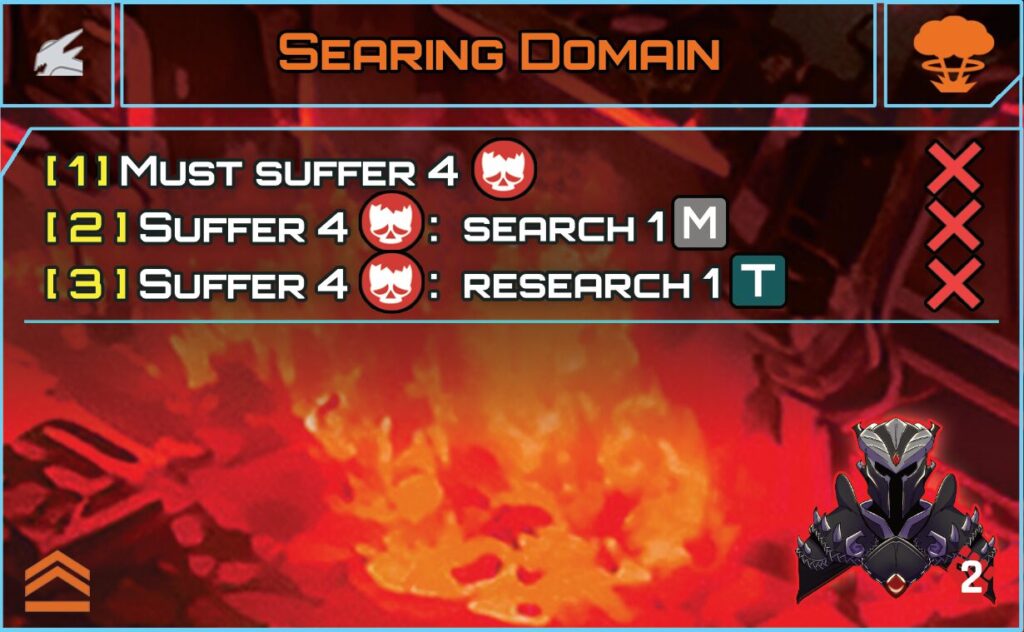
It grants the opposition 2 strength at the district the landmark is placed upon and has the unique effect of searching the mission deck for any 1 mission and drawing it, which can be significant for lining up a big power play.
So how does this unique landmark enter play?
It is linked to the opposition’s devastatingly powerful upgrade, the Drakownite!
With 5 strength, it is the most powerful unit in the game. It will blast a district with the Searing Domain landmark before descending the bombed district in a terrifyingly beautiful blaze, giving the opposition a whopping total of 7 strength at the district it bombed!

Remember, if this explosion happens to overwhelm any candidates’ personnel or destroy their fortifications, these will allow the opposition to fulfil their opposition missions.
It certainly seems that the overlord is firing on all cylinders. Do the candidates have any additional means of fighting back, or is the situation completely grim? If a player does somehow manage to overwhelm the Drakownite unit, they will acquire an additional 3 power for their efforts, so 6 power in total: 1 for dominating the district, 2 for the overwhelm, and 3 because it was the Drakownite unit that was part of the overwhelmed forces.
Candidates also gain access to upgrade level three cards that can provide some relief against the event dice, through the employ of force favour!
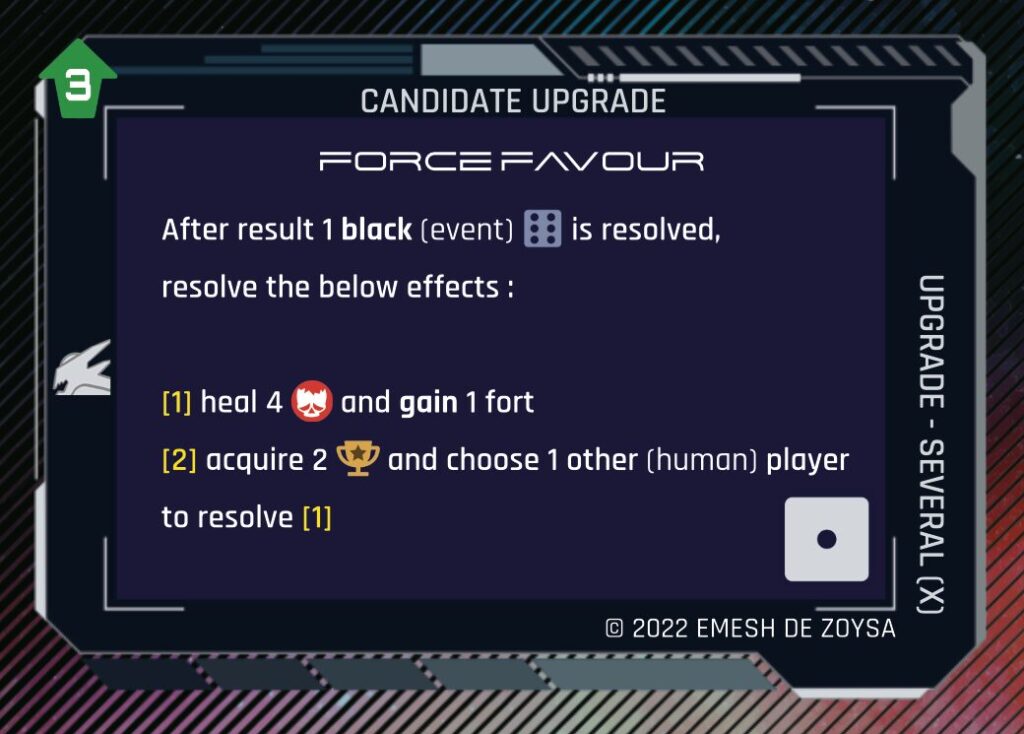
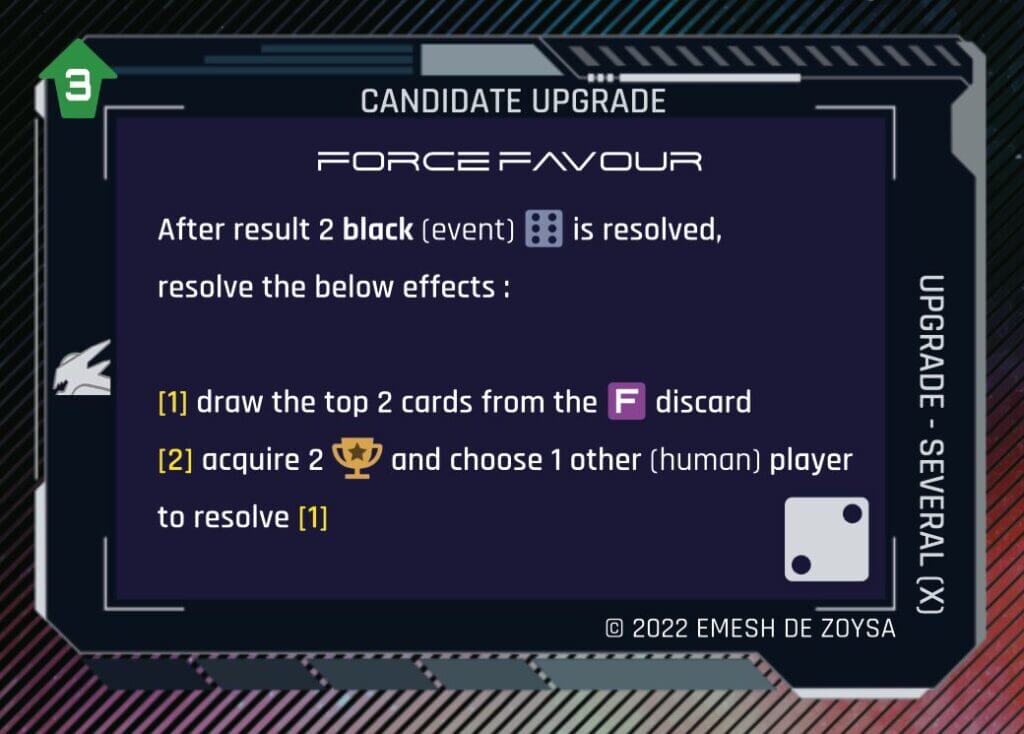
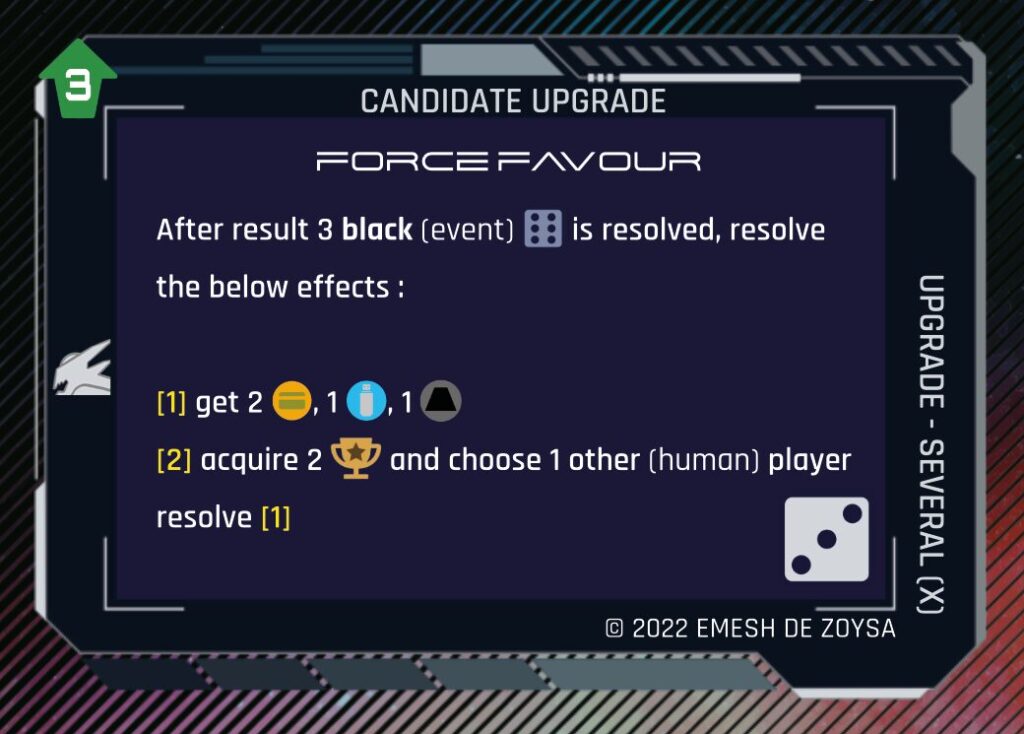
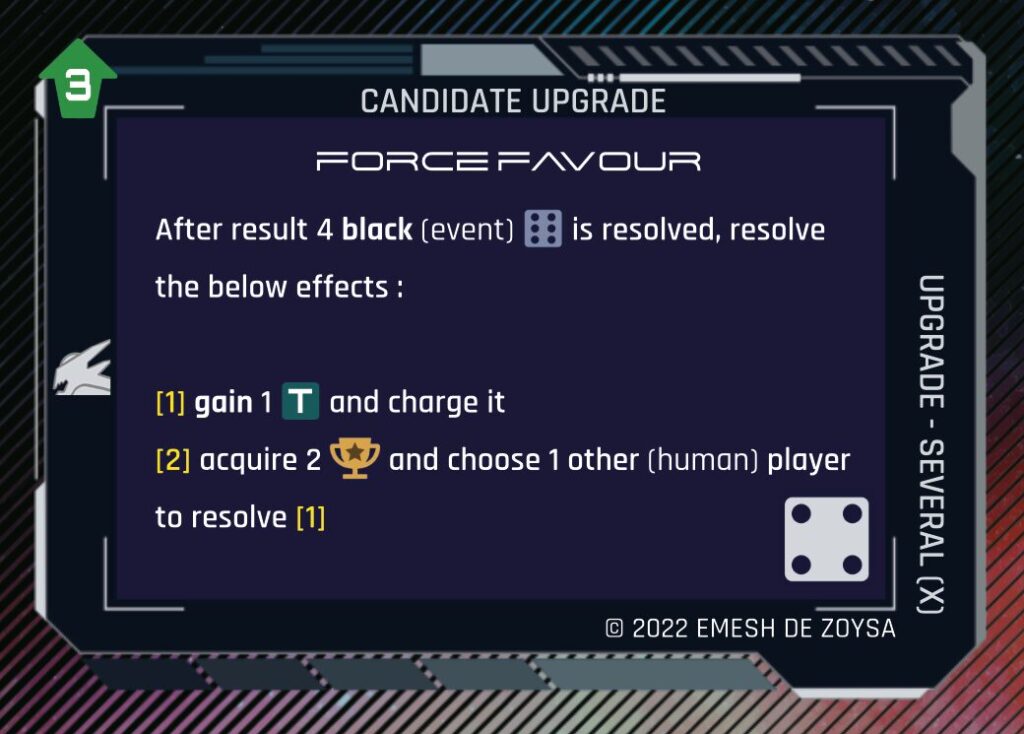
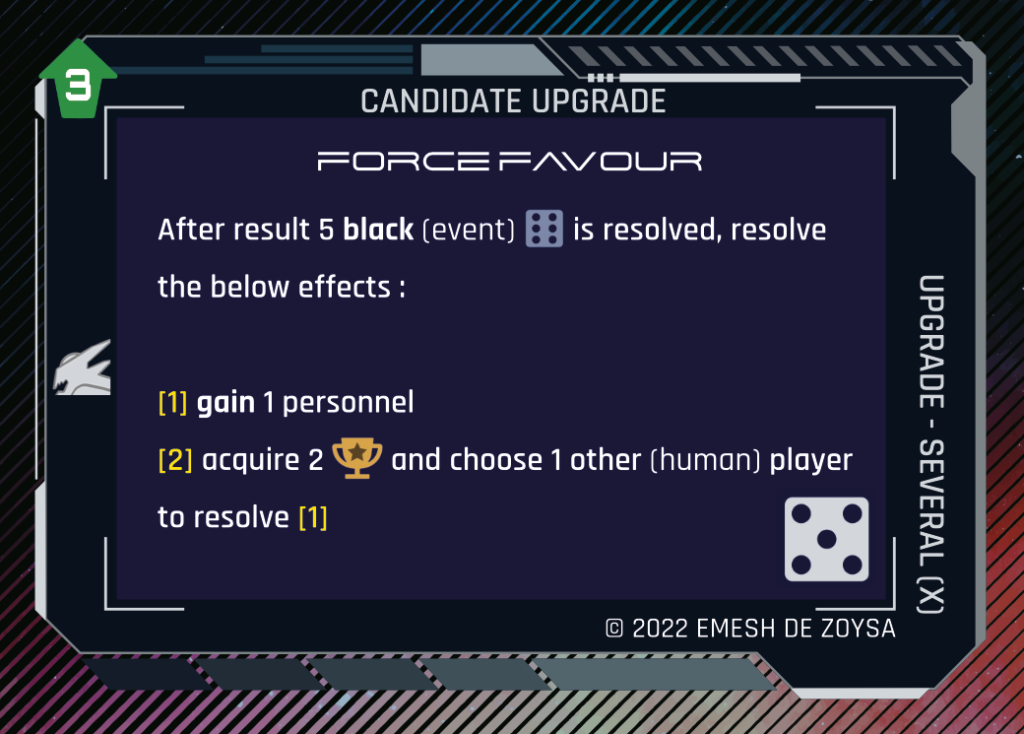
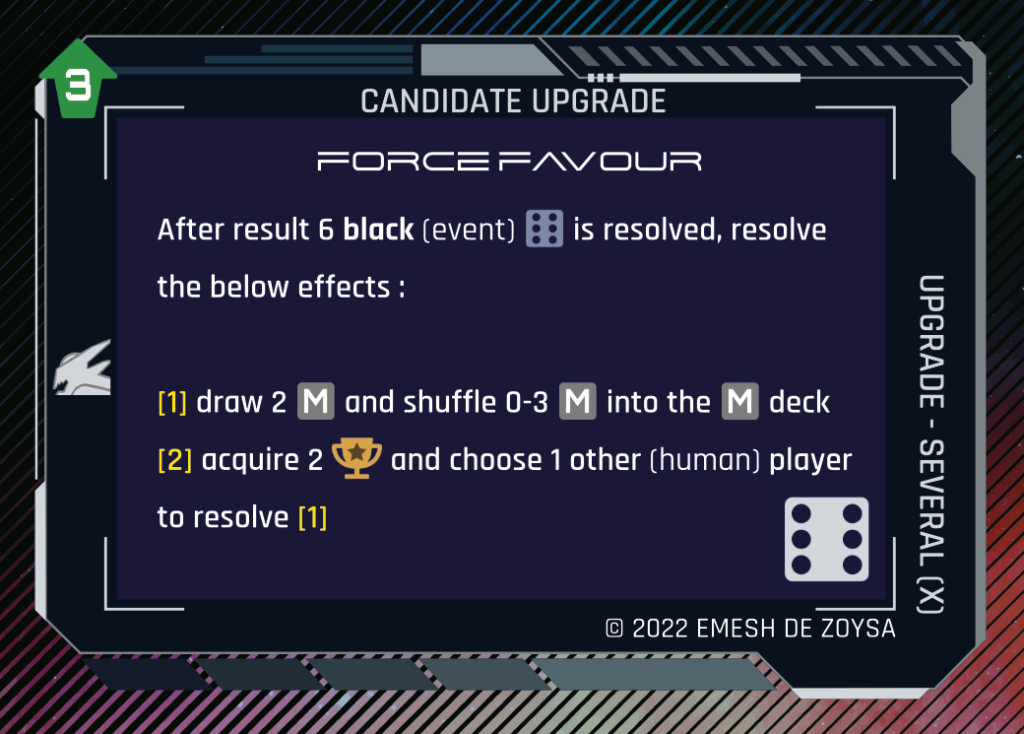
Each candidate is dealt one of the six force favour upgrades randomly at the start of the game, and unlocking it allows a candidate to gain a powerful benefit when a specific outcome of the event dice is resolved. In multiplayer games, a candidate can choose another player to also gain the powerful benefit. Note that the detrimental impact of the related event still triggers however!
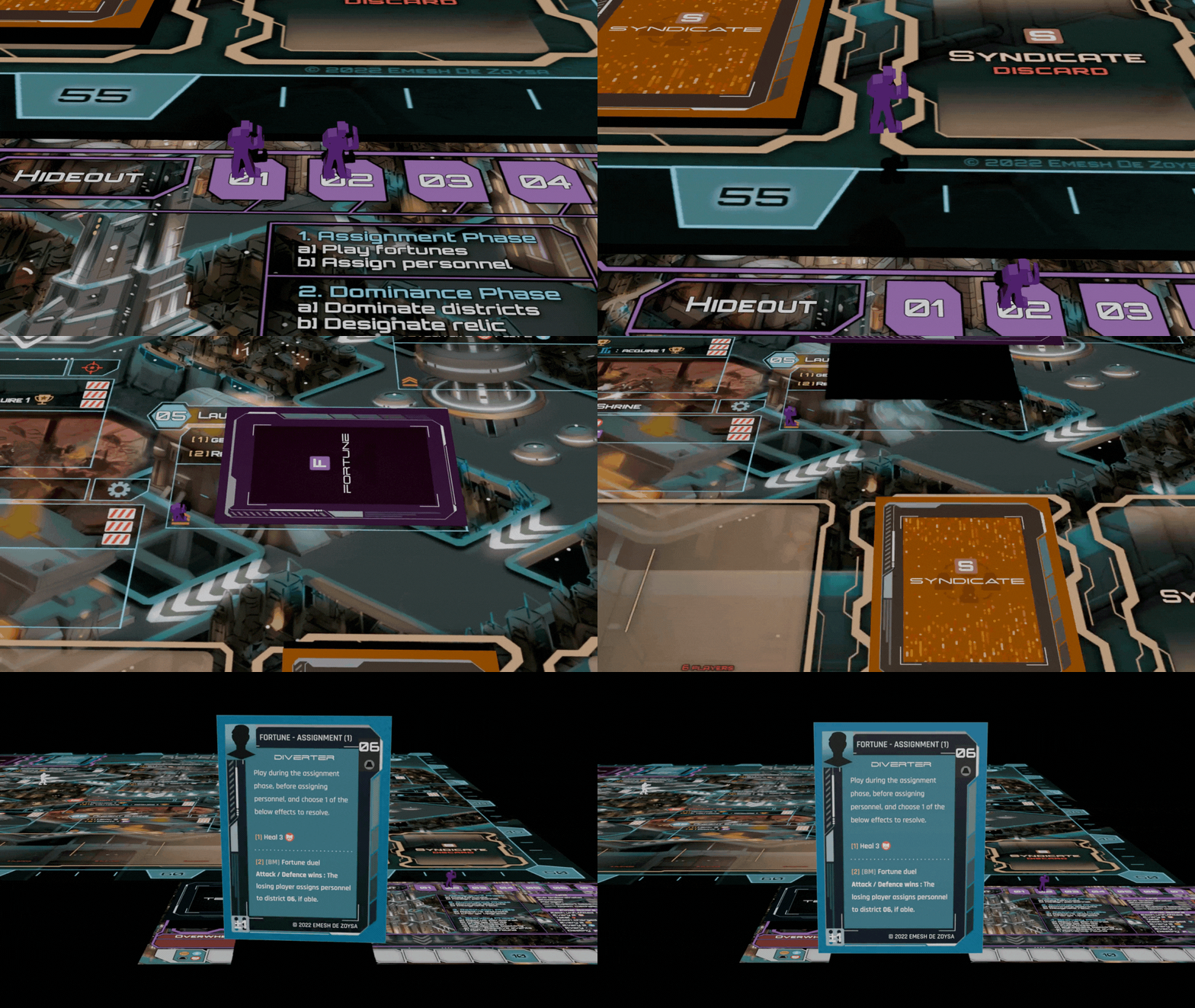
Due to the chaotic nature of a rampant AI, at the start of the game, each district that does not contain a landmark is overlaid with a fortune card.
The citizens are in need of dire assistance, and coming to their aid will surely prove to be worthwhile!
On a first come first served basis, candidates can assign personnel to a district containing an overlay fortune, and then immediately add that fortune to their hand. This will allow for a couple of rounds with extra fortunes to work with, helping candidates set-up faster or possibly hindering the opposition.
RAID Mode
If you are anything like me; I suspect most people are not, but if you are, then you likely have frequent fantasies about being the final boss. RAID mode was created with this concept in mind.
People who know me and play games with me, know that I possess a deeply strategic mind; one that almost allows me to see the future, within the realms of a tactical gaming environment. I imagine it is something akin to chess players who can predict the outcome of a game 20 or so moves ahead.
This power of mine however, is both a blessing and a curse. True, it leads me to victory more often than not. However, there comes a point where the tide of the metagame turns against me.
When people get sick and tired of me ‘winning all the time’ – hyperbolic, but you get the idea – the masses team up against me. Within the construct mechanics of most PVP games, these are not designed for a single player to have any real chance of victory while subjected to arguably unnecessary repeated assaults on multiple fronts, with little to no let up.
There have been times where I have deliberately held back, by making sub-optimal decisions, in order to fit in. Or continued to play a game I no longer wanted to take part in, to try and keep the peace.
No more.
This is where RAID mode comes in. By establishing the premise at the onset that one player embodies the super powered overlord opposition, the social construct of ganging up against the strongest player, is reinforced with game mechanics that now allow for a fairer contest.
This mode includes the overlord as a human controlled opposition. It shares much similarity with AI mode, but with less arbitrary AI and more human precision.
Because a human controls the opposition in RAID mode, they choose where they assign their personnel each game round. By that same token however, they lose the AI ability to reassign personnel to districts already containing their personnel, and unlike the AI, the human opposition is able to get resources – both beneficial and detrimental.
In fact, the opposition player starts the game with a whopping 13 strain, representing the relentless agony the overlord is subject to. The opposition player will need to spend time reducing that strain, lest their most powerful unit, the Drakownite, become a double edged sword; a pyrrhic weapon.
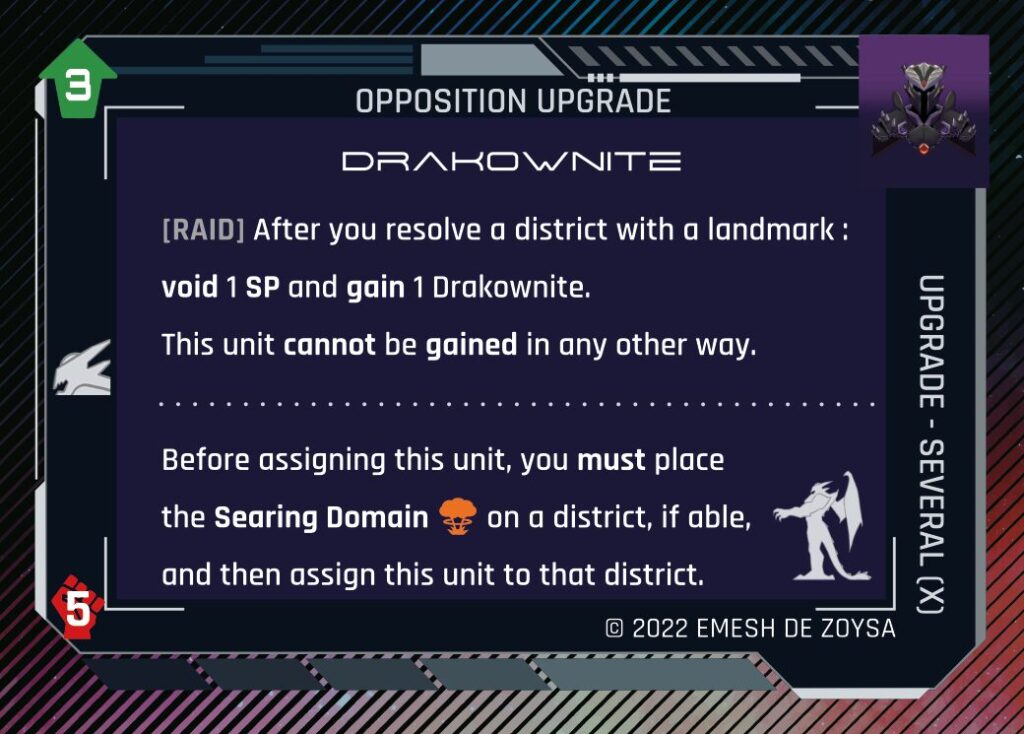
The Drakownite unit may be unmatched in strength, and is essentially a precision tactical nuke in the hands of a human controlled opposition, however unlike the predecessor doom mechasuit unit, the Drakownite does not have the same protective ability when placed on an obliteration landmark; at least when it is controlled by a human, or more thematically, a cyborg overlord. In other words, the human controlled opposition player will suffer a minimum of 4 strain when assigning the Drakownite unit to dive bomb a district.
There are a couple of workarounds to this potential conundrum, the main one is that the opposition card has a nifty ability that prevents district explosion landmarks being placed on districts containing their own units. The human opposition player can use this effect to their advantage by assigning the Drakownite to districts containing their own units, to prevent the Searing Domain landmark from being placed.
In this manner the game is kept fair. The opposition player has a targeted tactical nuke, but if they use it offensively to blast away other player’s units, there is a large strain penalty to suffer, but if it is used to reinforce one of their fortified districts, in a more defensive manner, the suffering is avoided.
Regardless, RAID mode makes the overlord a true terror to face-off against, and candidates will need to form temporary alliances and work together to keep the human controlled opposition in check.
To help facilitate such relationships, Project RAID comes with a new type of card: Imperatives. These offer optional new ways of changing the fundamental rules of the game by warping the expected way that things work, or by adding entirely new game systems. Two are included in this expansion, but more may be on the way.
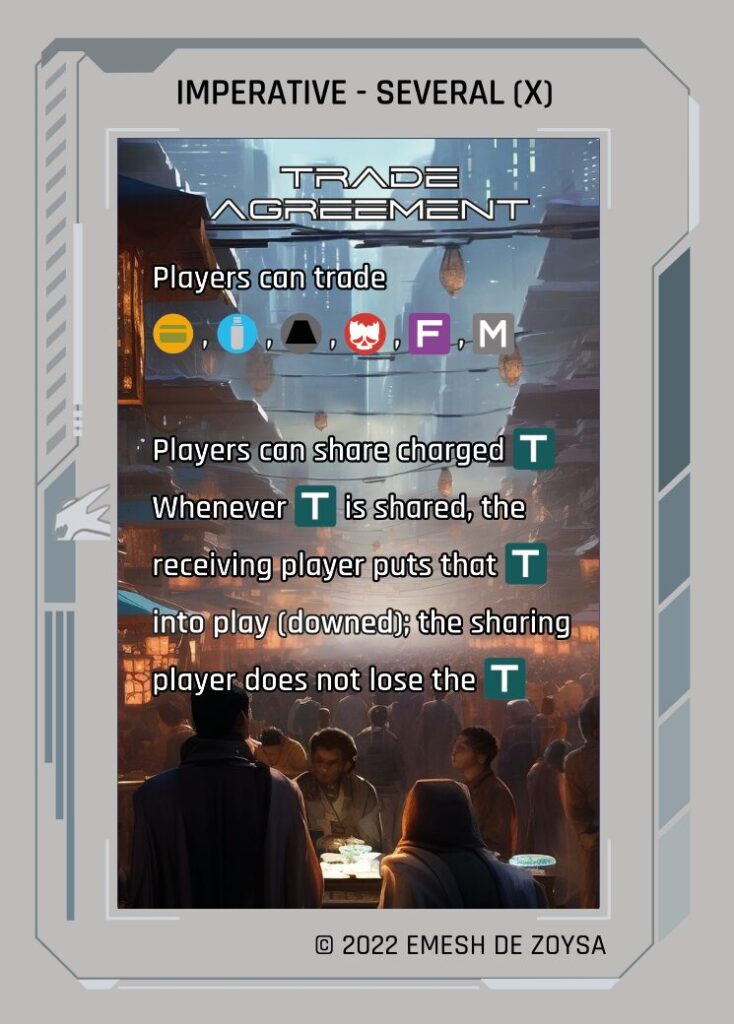
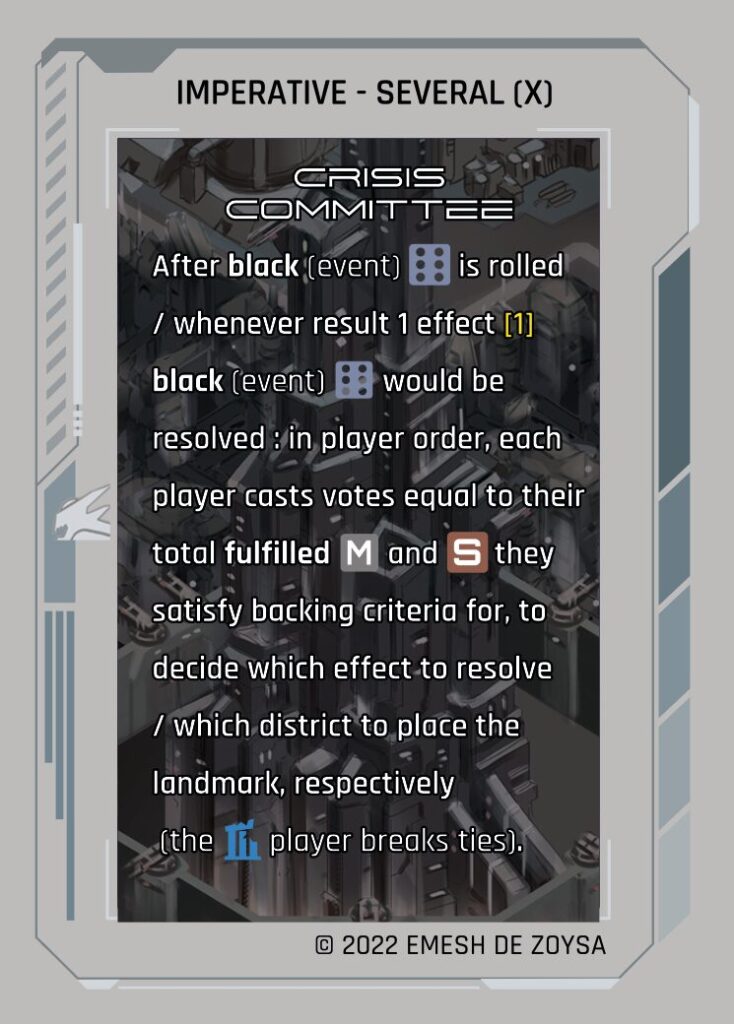
The first imperative is Trade Agreement. This introduces a new concept known as deals, which allow players to trade resources, cards in hand and even share technologies. It is possible to reduce another player’s strain, as long as someone else is willing to take on the strain instead! The other imperative is Crisis Committee. This introduces a new concept known as voting and grants each player the ability to influence the outcome of each event. It even grants players the power to vote on which district gets bombed each round. Be careful where you build your fortifications!
These imperatives are designed to grant the candidate players advantages against the opposition, but they can of course also be included for use in base games, along with the overlay fortunes and Force Favour upgrades as previously discussed.
Conclusion
A lot of the advanced game modes will challenge candidates to adapt their usual game plan. Strategies that worked well in the past may not necessarily transfer across well when going toe-to-toe against the overlord. Likewise, plays that never likely have been considered may prove to be intriguingly viable.
Candidates who try to focus solely on getting their engine online, while ignoring the political situation at the Astral Tower, are likely doomed to fail.
Risk mitigation plays a large part of the challenge. There is not much candidates can do to reactively respond the overlord’s gimmicks; but rather, it is more about taking a proactively prepared approach instead, to reduce the odds of getting punished.
It can be very tempting to blame the system when losing due to an unlucky event trigger toward the end of the game. But unlike many other games, the possible event outcomes are public knowledge.
In other words, when a candidate makes a move that increases their risk of punishment from a certain event outcome, that candidate consciously – or at the very least, unconsciously – has accepted the risk when making that move.
Should candidates go all in on a particular strategy and hope the related event does not trigger and punish them? Or do they choose to spread their bets, making it more likely to be hit by events, but reducing the overall impact those events may have?
Candidates will need a high degree of strategic planning and tactical adaptability if they wish to succeed against the overlord’s challenge.
Whichever mode of operation you choose to engage the opposition against, Overlord Drakow ‘Counter King’ is one of the most dangerous entities within the Black Metro universe. Will you have what it takes to duke it out against this high-powered opponent and overcome Project RAID? Find out when Black Metro Project RAID releases at the end of 2025!
Take down the Overlord’s AI program with Black Metro Project RAID for Black Metro: The Board Game, available here.
PNP version available here and digital versions available on Tabletop Playground here and Tabletop Simulator here. Digital rulebook found here.
Mission Complete – Overlord Drakow signing out.